Marks
and Spencer
|
Girdles
|
 |
In 1967, this charming lady of my acquaintance displays what the
perfect middle class lady in her early 60's would wear to a wedding. Silk
twin-set and pearls, hat, gloves, long-line bra and zippered high-waisted
girdle from Marks and Spencer.
So I wrote in the chapter on Weddings. Millions of women wore Marks and
Spencer, and many, who could well have afforded Spirella or even Rigby and Peller, chose the favourite brand of the British High Street, and for good
reason, as is described below.
In Britain, the girdles
of Marks and Spencer occupy a prominent niche in the foundation garment history of the
nation. From the early 1990's to the present day, M&S, as we shall call the company,
provided support to millions of women. During the 1950's to 1980's they provided
girdles that were unmatched for strength, durability and style. However much I
might praise the made-to-measure foundation retailers, M&S captured a huge
proportion of the market during those years. Consider the all-satin /
satin-elastic girdle of the 1960's. It was a classic of its time, and the fact that so many still exist in
the drawers of the elderly and fashion-conscious implies a change in fashion
rather than the wearing out of the actual foundations themselves.
|
|

|
|

For
connoisseurs of the brand, they are (clockwise from top right), model
956B, waist 28, hips 40-41 (well worn), model 1903, 29/39-41 slightly
worn, model 956B (new), 30/42-43 and model 714 (NIB), 32/44-45. The oldest
and most worn is a strong and as supple as the new models although a
patina of yellowing has suffused the garment. My husband worked on the
image for a while and, for artistic reasons, increased the contrast beyond
reality, however, the silver and gold appearance of these superb
foundations justified this ‘poetic licence’. |
We
are rather lucky to have six satin elastic girdles in our collection. They
are the popular sizes of 28 – 30” waist and two are unworn. Three have
been worn a bit and the other, I imagine was the regular girdle for a
middle-aged women in 1970. All are as tight and as strong as the day they
were manufactured. I sometimes feel that those girdles, even if worn on a
daily basis, would last my lifetime.
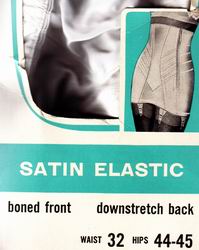
The
714 is perhaps my favourite. It is unique in having the inner facing of
the bone casings in satin rather than cotton. The attention to detail on,
what after all was just a high street brand, is simply amazing. How often
do we pay for a named brand and come away the envy of our peers, but
actually disappointed inside. In all honesty, I’ve never seen a Spirella
or Spencer as well made as these garments.
 |
|
Early Days
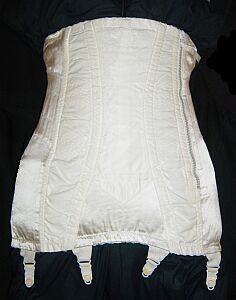
Marks and Spencer's first girdles
were sold under the "St. Michael" brand name in the 1950's. The hook side
version shown here is made of corset quality tea-rose satin, and has the
unusual feature of an additional waist strap, presumably to achieve the
waist required for the 1950's fashions. This girdle (which for many would be
called a corset) is exquisitely detailed; notice the apron front and the
old-fashioned suspenders. |

|
|

|
To be honest, this beautifully constructed foundation
quite escapes my memory. Both my husband and I well remember the satin
elastic girdles and the rows of boxes in the high street branches of
Marks and Spencer, but neither of us remembers this.
We were amazingly
lucky to find one in such excellent and unworn condition. If I could find
a friend with a 25" waist, I'm sure the girdle would be eminently
wearable and long-lasting. The elastic is of a gauge not used in
foundation garments any longer.
|

|
Classic Girdles


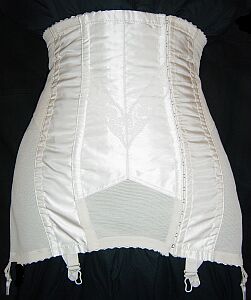
The
fabulous satin elastic M&S girdle from the 1960's. These seriously strong
garments, finished totally in satin elastic, were some of the greatest foundation
garments ever manufactured for the masses.
The
evolution of the traditional M&S girdle. (Bottom right, there is neither
satin, nor even shiny nylon, nevertheless, this girdle is as strong, as
long-lasting and as powerful as her sisters.)
Each year M&S subtly changed the
panelling, but the entire construction in satin elastic was a feature of the
first of these foundations (top left). A later model incorporates some nylon
flanking the central front panel, but the majority is satin elastic (middle right).
Hook-front was an option instead of the metal zipper on this exquisitely
panelled girdle (top right). In the 1970's, heavy elastic replaced the satin
at the sides and the front was faced in fancy nylon (bottom left). The serious
boning over the tummy is obvious. The boned 'roll-on' without zip or other entry
was the last incarnation (bottom right). For many British
women, this girdle was the
final 'open bottom garment' that they would wear before changing to tights and
the panty-girdle. All these examples come from the 1960's and 1970's, and are as wearable today as when they were new.
Something that is often forgotten, is that all these girdles
were available in black as well as white. Flesh, and skin-tone, were not
fashionable in the 1960's and 70's. |
 |
 |
|
The Pantie-girdle
At the beginning of the 1970's, even with such beautiful
foundations on offer, the majority of Britain's middle-aged women suddenly
realised that a social revolution had occurred. The Beatles, Carnaby Street,
Christine Keeler and the Swinging Sixties had moulded their daughters'
attitudes, and mature women decided that the panty-girdle would mould theirs.
The girdle and the corset of their mothers were discarded within a few
years and Britain changed forever. Contrary to popular fiction, it was
the daughters that forced their mothers into foundation garments, not the
other way around!
The model on the right is from the very early 1970's, and possesses the
satin panels that were the hallmark of its American cousin. Even the
vestigial bow is present at the waist. It would take another decade before boning at the
waist would be eliminated. In the evolution of the panty-girdle,
the suspender attachments have vanished, however, that weird and uncomfortable
'gripper band' is present at the bottom of the legs. Who on earth would trust
the security of their stockings to such a fallible system? |

|
|
|
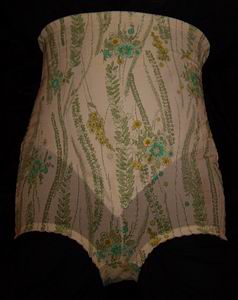
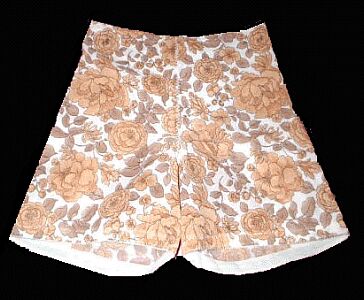
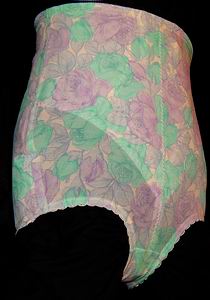
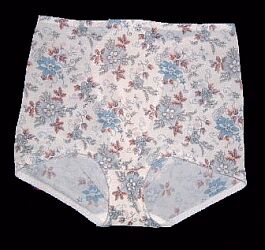
Flower power was neatly represented on many of these
panty-girdles from the 1970's. High-waisted, long-legged (but oddly never
together), they came in all styles, even with a matching brassiere.

As the 1970's
progressed, so the flowers vanished to be replaced by a purple hue, surely
one of the worst colours for underwear! The pantie-girdle at the bottom
centre represents the nadir of this collection. It looks like the knickers a
seven-year-old might wear.
|
|

For
a company that could produce the satin elastic girdle, the hideous
corselette above has plumbed the depths.
Shapeless
torso with hemispherical padded cups. 1974 |
It wasn't just
Marks and Spencer who flirted with colour; nearly every other manufacturer got
in on the act, and several were severely taken to task for portraying National
flags!
Women had become liberated and, when they chose to, could
dress as men. Unisex was the theme, and women started to wear underpants, albeit
perhaps with a slightly higher elastic content their husbands'!
This page brought forward two recollections from my
husband. Firstly, when he was studying at Oxford, he remembers that all the
students had to dress in regulation white shirt, black trousers, white bow tie,
academic gown and mortar board for the exams (I'm not joking)! Girls were
allowed a modification of this dress code, being white blouse and black skirt,
but coloured underwear (brassieres in particular) was prohibited. It was deemed
unsettling for the boys to see the colours of the brassieres through the thin
blouses. Shortly after university, my husband was working alongside an elderly
geologist, who, in an attempt to describe the colour he needed for a map said
"Oh, you know, it's the colour of ladies' underwear!" (implying
purple). He quickly added "Er, perhaps you don't know!"
|
Memories of a Marks and Spencer Husband
I
have seen it questioned why a woman with a 24-inch waist would need a girdle. In
2004 I'm sure she wouldn't, but back in the time when girdles were worn by just
about all women, waists were generally smaller anyway, and manufacturers made
and sold girdles in small sizes. Two of the three steady girlfriends I had in my
teens had waists of 22 inches, the other one was 24. At that time, Marks &
Spencer's light, medium and firm control girdles were sold in sizes starting at
waist 23/24, hip 34/36. That was the size bought by the two slimmer girls when
they started wearing girdles. (The third girl wore only a deep suspender belt at
the time I knew her).
|
The girl who eventually became my wife was proud of her small waist (and even
now it is only 24 inches) but was annoyed at having only a small (32) bust and
what she thought of as disproportionately large hips (35). She therefore bought
bras with slightly padded cups and wore a girdle to try to get her hips in
proportion to her waist and bust. For several years she bought a standard
M&S medium control (open-bottom) girdle, having tried a light control one,
and immediately taken it back as "useless, even to hold stockings".
She appeared to me to have a good figure, emphasised by the narrow waist, but
she always thought her bottom was too big, and would certainly not have gone
without her girdle for that reason. When she passed her 20th birthday she
pointed to a very slight bulge on her tummy and said her girdle was getting worn
out. She bought a new one but, on trying it on at her home, decided that it was
not strong enough to flatten her tummy and hold in her bottom. A return trip was
made to M&S and the medium control belt was exchanged for a firm one, still
in size 23/24 inch waist. When I first saw her wearing it, there was no doubt
about it; her perfectly flat tummy and tightly held bottom were very apparent.
She still had no need of any help at the waist but from then on she quickly
bought more firm girdles so that she could wear one all the time to help keep
her figure in proportion as she saw it.
One effect though of the heavier girdle was a tendency for some flesh to spill
over the top of the belt on to the girl's waist and for a slight bulge on her
thighs below the girdle hem. On several occasions thereafter, when buying a new
girdle in M&S, she checked the various styles to see if there was a slightly
longer one. As I remember it, she did not want a full high-waist girdle because,
as she said, she had no need of it. One day she asked an assistant who said that
the length increased slightly with the sizes and my girlfriend decided to buy
the next size - 25/26 inch waist and 36/38 hip. She tried it on and it was
slightly longer but "not as firm as my usual ones", she said. Her next
idea was to exchange that girdle for an extra firm one in which the smallest
size was 25/26, but she thought the additional strength would compensate for the
larger size. However, on examining an extra firm control girdle in M&S, she
realised it had six suspenders instead of the usual four and immediately gave up
the idea saying she "didn't want to be bothered with more suspenders; four
are bad enough". In consequence she bought another of her usual firm
girdles and never again tried to get anything different.
|

The classic girdle was actually worn
by young women but it was their mothers that were the main customers |
That episode would have been in 1966. Only a few years later, she had begun
wearing pantie-girdles with tights, and found that the M&S firm ones were
not nearly as controlling as the girdles had been and, in particular, lacked the
down-stretch back panel that flattened her bottom so well. She felt more rounded
in the pantie-girdles. The pantie-girdles were also shorter, barely reaching her
natural waist and certainly not covering her thighs. Her waist was still only 23
inches, so the girdle was really only for hip and tummy control. By then,
M&S produced only the brief pantie style in size 23/24, obviously assuming
that women wanting more coverage would be larger. My wife, as she then had
become, was still concerned about big hips, and tried a couple of short-leg firm
control pantie-girdles from M&S , that had to be in size 25/26. I remember
these well because they came with a little packet of attachable suspenders which
my wife threw away immediately, seeing no possible reason for wearing stockings
with a pantie girdle. The new girdles also came higher at the top but were
understandably quite loose on her slim waist. Nevertheless, she liked the smooth
waist to thigh fit and wore those girdles quite a bit, though she found the legs
a bit uncomfortable especially when they sometimes rode up. The old ritual of
tugging down the hem of a risen girdle was replaced by the occasional pulling
down of pantie-girdle legs.
Pregnancy then intervened and, after the birth, my wife returned to her regular
pantie-girdles. Unsurprisingly, she was not as svelte as before her pregnancy,
her waist now being 25 inches. She was more worried, though, about her hips and
tummy and complained that her old brief firm control (size 23/24) pantie-girdles
were not very good. The short-leg ones were better, but starting to wear out.
Having for years bought all her foundations in M&S, she was surprised to
find in (I think) British Home Stores (but might have been Littlewoods) a new
range of firm pantie-girdles which had a non-stretch front panel, a satin
down-stretch back panel and were available in size 23/24. She bought one, found
it much firmer and liked especially the effect on her bottom and tummy. Her
waist once again gained a "spare tyre" from the tight girdle and
within a few weeks we had returned to the shop to buy another identical girdle.
She saw that there was a longer style in the same range, described as a
cuff-waist girdle and available in 23/24 waist. She bought one of those, too.
For some reason she found that one distinctly tighter and on one or two
occasions, having worn it under a dress to go out, took it off as soon as she
got home and put on a regular length one instead. By the time she became
pregnant again, my wife's waist was back to an ungirdled 24 inches.
After the second child was born, my wife found the panelled girdles too
uncomfortable, and reverted to the standard M&S brief, firm control styles,
still always buying 23/24 waist. This time, again finding a distinct spare tyre
above her girdle around her waist, and realising that it could be seen when
wearing dresses fitted to the waist, she bought a high-waist firm control girdle
from M&S. It was in size 25/26 waist (smallest available in that style),
which again made it slightly loose in that area, and had six bones; long
ones at the sides, shorter ones at the front and back. She disliked the bones,
especially the side ones which didn't follow her curves closely enough. The
girdle was also a coloured one, pale blues and lilacs, so she liked that. It
gave her a good smooth shape but she said it was no good under straighter skirts
because it was not strong enough on her tummy or rear.
This is a charming account from a gentleman, whose wife, although as slim as
many of us would dream about, still suffers from those feminine traits of
self-doubt. The history of M&S from the 1960's to the 1980's is very
accurately recounted.